Thursday, December 20, 2007

Forged Documents and a Bolivian Jail in La Paz


Beaurocracy is a nightmare. In response to the United States' policy on visas for bolivians, Evo Morales has enacted a policy that went into effect two weeks before Dave and I crossed into the country. In addition to $100 and an invitation from a host country national I needed proof of a yellow fever vaccination. I received the shot in Panama, and had brought a copy of the document knowing full well that I would need it eventually. At some point during the first six weeks of travel the papers grew a pair of legs and walked off to go tour South America by themselves. No problem though, a little work with a copy of Dave's vaccination record, a copy machine, and some white out, and we soon found ourselves on our way to La Paz, Bolivia.

It took only ten minutes of being in Bolivia me to turn to Dave and say, ¨I can already tell that I am going to like this country.¨ I can't say exactly what it was, it could have been the uncomfortable bus, the local music on the radio, the bumper stickers that lined the inside of the bus, the drunk guy wanting to wrestle, or the going into blind curves three cars abreast which turned into a well ochestrated symphony squealing breaks, screams, but no crunching of metal. I can't put my finger on it, but there was something about the creative and unsafe way things were done that just felt right.

Case in point. At one point we had to cross a 500 m section of Lake Titicaca. We grumbled about our seperate uncovered boat until we saw the ¨ferry¨ that carried the bus across the channel. It was made of plywood with a minimal support structure. Just long enough and wide enough for a full size bus to fit on with a foot of clearance all around. As the boat rocked on the wind tumbed water of the lake, I couldn't help but wish I had my camera for two reasons: one to take a picture of the craziness, and two to protect it from the icy water that seemed inevitably sure to tip the boat and consume our ride. I did find this picture on the internet. It is of the same crossing, but our bus was at least twice as big as the truck in the picture.

We arrived late into La Paz, and the next morning we go out to walk around the highest capital city in the world. How high is La Paz? La Paz is so high that FIFA World Cup does not allow world cup games to be played there. In the history of the world cup Bolivia has NEVER lost a game there! In addition to a perfect home record, La Paz is an amazing city.

When inquiring about Bolivia on our way south the response was almost universal, Bolivia is great. But when asked specifically what it is about Bolivia that makes it so geat there is rarely anyone that can come up with anything besides it is cheap. I now understand their problem with being able to describe it, because it is more of a vibe that one gets than specific list of things to do. In general, the major difference though is that we are not treated any differently than any local. We don't have to barter with taxi drivers, no one openly stares, and people have gone out of their way to be helpful and knowedgeable.

One of the attractions(?) to La Paz is the San Pedro Prison. It was popularized by the book Marching Powder about an English drug mule who got caught trafficing cocaine and was imprisioned. In order to survive in a Bolivian prision the inmates must make their own money usually though artisanry. So the intrepid Englishman began to run tours through the prision to buy dinner, and became such a big cult tour that the bolivian govenment has banned tourists from the premesis. Dave and I went and looked in because it is right in the center of town, and though, ¨It's crazy to bribe our way into a prision in Bolivia!¨ and ¨It's not the getting in I'm wrried about, it's the getting out.¨ So we chickened out, and didn't even try to get in which should bring my mother's blood pressure back down to normal levels.

But this might send it back up... I don't think it will surprise anyone to know that the most dangerous road in the world is located in Bolivia. Another strange tourist attraction is to ride bicycles down this road to a near by town.

Sunday, December 16, 2007

Final Breakdown on Perú:

Country of Origin: Ecuador
Total time in country: 19 days
Music: Besides the noise that the locals seem to call music there are also full CDs in most tourist locations that are dedicated to the Andean Flute redition of Beatles songs and old 80's hits. Immagine hearing 'Sweet Child of Mine' without the guitar intro or 'Hey Jude' without Paul McCarney screaming at the end.
People: I think the genuine people are out there, we just didn't find very many of them.
Transport: Decentralized bus terminals suck.
Landscape: Lots of extremes... Extreme mountains, extremely dry desserts, and extremely pathetic looking mud houses, extremely cool reed houses on reed islands.
Food: Besides the cheapest food thus far (a full lunch with soup and plate of food for less than a dollar) the shining star was the Peruvian tradional dish, ceviche.
Safety: Northern Perú is the least safe I have felt, ever! Most of the touristy places have safe areas and non-safe areas. It's good to know where the lines are.
Gas prices: 14.70 Nuevo Soles per gallon (4.90 USD per gallon)
Surprised by: Despite a country that has tourists all year round I still feel like I was stared at, single out, and generally preyed on more than in other countries.
Final word: Perú has some really cool hiking, climbing, ruins, and history to do and see, but afterwards get out.
Next stop: Bolivia

Sunday, December 9, 2007

A Lake so Nice They Named It Two Times Twice, Lake Titicaca


Note: After catching some flack for a historical fiction story on the Galapagos based on a bird species I will be refraining from making comments throughout this article on the name of a certain lake that may or may not be referred to as something that could be construed as hilarious. I will allow the reader to make the appropriate inappropriate joke him/herself.

Lake Titicaca, the highest navigable lake in the world. How high is it? At 3810 m, it's soooooo high that [editor deleted inappropriate joke]. I'm still not sure what make a lake navigable and others not, but I can tell you that this altitude does not allow for casual swimming. I am all about a good polar bear swim, but I got no where near the 'point of no return' when I went wading into the water (it is colder than Crater Lake). Because swimming and lazing in the cold atmosphere did not appeal to us we found ourselves in a pickle until we heard about other peculiarities to explore in the area.

Puno, the town where one stays when visiting the Peruvian side of the lake is NOT one of these peculiarities. It is an uninspiring parched city that does not deserve one red (or any other colored) tourist cent. After touring the inside of several Internet cafes we busted out on a two day tour of some of the nearby islands.

If the foolish man built his house upon the sand and the wise man built his house upon the rock what does that make the people who build their houses upon floating reed islands? That's right, these two meters thick and several thousand square feet islands float on Lake Titicaca made of reed. These people's entire livelihood is based on the large grass that they get from the lake. They use it as cooking fuel, make their houses, boats, artisan goods, eat it, sleep on it, oh and did I mention that their island is made out of it? I have to imagine that this is the most unique place I have ever seen anyone living.

It is assumed that the reason these people are living how they are was to avoid the Inca's as they took over South America. To escape capture, waterboarding (amongst other torture techniques), and an assimilation process that makes the Borg look friendly these people moved onto their boats to live. Eventually they started tying the boats together to make small islands. Today the spongy reed covers a large enough area for them to have a volleyball court complete with net and ball.

There are multiple floating islands and when I asked one of the locals about this phenomena he just smiled and looked at his well used saw. Can you imagine your neighbor inviting you over for a drink one day, and as you walk out of your house the next morning with a wicked hangover you discover that your neighbor is gone. In fact the entire island that you use to live on is gone except for the small portion that your house sat on which fortunately you discover still softly under your feet. Oh well, I guess you would just have to grab your reed paddle and go tie up with another island.

After the morning on the floating islands we went to an earthen island were we stayed with a local family. These host families speak no English, but are still kind enough to invite tourists into their house. I would imagine that the room we stayed in is nicer than theirs, but I didn't get the chance to verify. Dave and I sat in the kitchen very comfortable in the awkward silence between the races because it gave us flashbacks of our days in the Corps.

After dinner we went to a night club in the plaza (read: large spare room in a store) and danced with the host family in their traditional no-rhythm style, and I fit right in. After a while some of the locals who were looking for a laugh came in to watch the gringo dancing mayhem. The guide introduced us, and for the first time in three weeks in Perú we found some real people that like the same three jokes I told in Panama. Things were warming up to be a late night talking and joking around when hour hostesses came up and told us it was time to go. We had no flashlight and even less idea where the house was, so we had to leave. Figures.

The second time around in Puno was no better than the first, but we did go out for one last-ditch effort to find cuy. The little rodent is expensive by local standards, and is only consumed by them on special occasions. It has a dark turkey meat flavor with a hint of gizzard, but the big turn off is it comes in the skin. The skin is chewier than leather, and the fat on the inside is worse than boiled pig fat. In fairness it was not horrible, but I'd rather eat alpaca or lamb any day of the week. With this quest finally accomplished we could finally bit bon voyage to Perú and get into the budget friendly Bolivia.

Friday, December 7, 2007

¨De Thooper Mountan Haykerth¨ on the Inca Trail


The classic four day trek along the Inca Trail to Machu Picchu, one of the New Seven Wonders of the World, is (not surprisingly) monumental! The majority of the hike was done on the original path build by the Incan Empire in the late 15th to early 16th Centuries. The ruins along the way teased the senses but do nothing to prepare the hiker for crossing the final pass at the Sun Gate early on the fourth day. December is considered to be the off season, but on the last day I found myself waiting in line to enter the final day with 199 other hikers (200 passes are issued daily). Thus the last day feels more like being herded than a peaceful sunrise walk in the Andes. During the walk down into Machu Picchu all the mooing was gone and there were nothing but smiles lining every face.

The guides took their time in the four day trek to give a prideful and comprehensive history of the Incan culture despite my doubts about their historical accuracy. They spoke English well, but the main guide always spoke with a smooth, sexy, Latin lisp (and a twinkle in his eye), and always called us, ¨the super mountain hikers,¨ which came out phonetically what I titled this blog. For all it's glory and international recognition the militant Incan Empire was only dominant over the Cuzco Valley for about a century, a historical blink of the eye.

Despite the empire's demise the locals are still proud to follow the three rules of the Incan Empire: don't lie, don't steal, and don't be lazy, 500 years after the fall. This was most evident in the porters. The porters on the trail at times would run in their shoes made from old car tires, passing the tourists who were generally struggling with the steep terrain and/or the altitude. Normally Latinos don't walk like they have somewhere to be, and they are generally content to get there when they get there. Being stuck behind a sauntering Latino on a narrow sidewalk was a frustrating experience until I learned how to walk like them. On the Inca Trail I found that the shoe was on the other foot. The 48 km (30ish miles) took us four days to finish, but the fastest porter ever completed it all in only 3 hours and 45 minutes. Note: this happened one year at the annual porter race, he wasn't carrying a pack.

Going up to the highest pass of 4200 m (13750 ft) I tried to pace what appeared to be one of the weaker porters. I kept up and probably could have passed him, but was not interested in getting into a battle of wills with him. Oh, i didn't mention that he was about half my size, his pack was at least twice as big as mine, and he was doing it in sandals. I was impressed, but am still trying to figure out how they still have any cartilage in their knees.
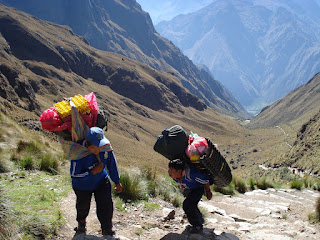
In our group of 13 tourists there were 17 porters. In a given day there are 200 permits for tourists and 300 for guides and porters. I am still trying to wrap my head around why one of them needed to carry a table and stools, another carrying a kitchen tent and mess tent, and yet another carrying three cups per person, full silverware, plates, bowls, napkin holders, and fake flowers for a table setting. My guess is the reason for all the extravagance is to give people jobs at the expense of tourists, but even most five-star hotel managers would be saying, ¨Geez, that's a little over the top.¨

One area where I was glad to have so many porters was when it came to the food. I have not eaten that well in a long time. There were five course meals three times per day, tea and popcorn at 5:00 pm, and daily trail snacks. I still think I was the most impressed by the pizza we ate on day three, but the hot coca tea in bed every morning to start the day was a close second.

On the first morning I was still enjoying my tea as my Irish roommate Eion was out preparing his bag for the hike. One of our Austrailian group members walked by and said, ¨Top of the morning to yeh.¨ (Note: According to Eoin no one actually says ¨Top of the morning to yeh¨ in Ireland. In fact it may be cause for punching someone in the face.) It was hard to watch his reaction while trying to not shower the tent with coca tea through my nose. He looked at me and turned a fire engine red that I did not think was humanly possible. After our hike was done and we were sharing a pint (in an Irish pub ironically enough) some of the others chimed in to get him to say, 'There always after me lucky charms.' Again Eoin turned his bright red and announced, ¨Noo, he'z (and points at me) bean tryin' ter get me to sey dat fer tree weeks nao. I doon't care how many paynts ye put in me I ain't gunna sey't. And we doon't sey, 'top o' de marnin' to yee,' eider.¨

During the hike though we all took turns faking all the accents to the delight of the rest of the group and evidently the Pachamama (Mother Earth) because she smiled fondly upon us all four days of the hike. The great weather meant there were great views. If at anytime the hikers would lift their eye off the shoes in front of them, they would be greeted with the panoramic sight in all 360 degrees. Everywhere you looked there was always another steep mountain or river valley. Therefore there was never a bad picture to be taken. All of the pictures I took came out great, but there is not one picture that can adequately do any justice when 'seeing in surround sound'.

This is most noticeably apparent in Machu Picchu itself. The ruins are situated in the saddle of a ridge line connecting Machu Picchu Mountain and Wayna Picchu Mountain. On both sides of the former religious center the cliffs drop straight away into the steep valley below. On a clear day one can see sheer rock faces and cloud forests that rival Yosemite and the Grand Canyon.

The quality of the stone work in Machu Picchu in mind boggling, and has to be experienced to be believed. Granite was used for to create everything from temples, to retaining walls, to bridges build in cliff faces. Despite not having steel tools to shape the stones the more important building, alters, and compasses were fit together better than most puzzle pieces. In area surrounding the Sun Temple it is claimed to be impossible to slip even a credit card between rocks. After careful exploration and testing I finally found one spot that permitted my credit card to enter. To my surprise a brand new 100 Sol note came out, a gift from the Pachitata (the father spirit) himself. But the god got the last laugh in the end, because when I tried to spend the bill, I was informed that it was counterfeit. It was a good thing I didn't trade real money for the fake currency.

After a morning tour with the guide we were released to do as much walking as our tired legs would permit us. A small group of us bit off a big bit as we attacked and climbed Wayna Picchu. We were going to try to run the steep and narrow assent to try and beat the record until we found out the current standing record for Wayna Picchu: 20 minutes up and 5 seconds down. The view from the top of the bullet shaped hill in the background of the classic Machu Picchu picture did not disappoint. Those who take the time find at the top a panoramic view in every direction. s impressive as the buildings are in Macchu Picchu, Wayna Picchu is that much more extraordinary because of its towering presence like Skeletor's lair on the top Snake Mountain. The rock work is not as fine as in Machu Picchu, but as one squints, focuses, and stares it is hard to tell when the sheer cliff face stops and the Incan rock foundation begins.

The only downer on the whole trip was the torturous four hour train ride home. AIt was like in the beginning of Office Space when Peter is sitting in his car in traffic and gets passed by a man using a walker. The train was painfully slow with no leg room, smelly neighbors, and no hope of getting off (insert maniacal laugh here). I would have rather walked home in four days than have spent the four hours on that train.

The bookends of our the Inca Trail was spent in the tourist staging town of Cuzco. This was the actual center of the Incan Empire and Spanish strong hold for so many years. This means that there are some interesting ruins and combinations of spanish churches on Incan retaining walls. It was here that Dave and I were reunited, and eventually ran into Matt and Drew from PC Panama. We spent a couple of days echando cuentas and reminiscing about the good ol' days. Once back from the trek I ran around doing all the touristy bits in town that I had missed before. The painting of the Last Supper in one of the Cathedral gave me pause. I never knew that Jesus ate chinchilla and mangos at the last supper! Where is that in the communion tradition? Someone has been holding out on me all these years.

Cuzco itself is overly touristy and it is impossible to even sit in the Plaza de Armas and eat breakfast in peace. I couldn't get more than 30 seconds of peace at a time before someone would show up and start bothering me about buying something, donating money, or taking a picture with them. It got old really fast, but there were benefits too. In the evening when wee were ready for dinner we would barter for a lower price, and then go club hopping and drink the one free drink at each place. The whole mood of Cuzco got old fast, it was time to move on.

Friday, November 30, 2007

Perú's litter box, Huacachina


After a few days up in the cold mountains and knowing that I was going to be hiking through the frigid heights of the Andes to get to Machu Picchu I decided to take a sabbatical to the hot arid desert of southern Perú. On the way south I spent a grand total of 107.24 minutes in Lima, and decided that it was at least 100 minutes too long. I have heard nothing good about the place and saw nothing from the bus or bus station to change my mind. After giving Lima the slip I rocked down to Ica.

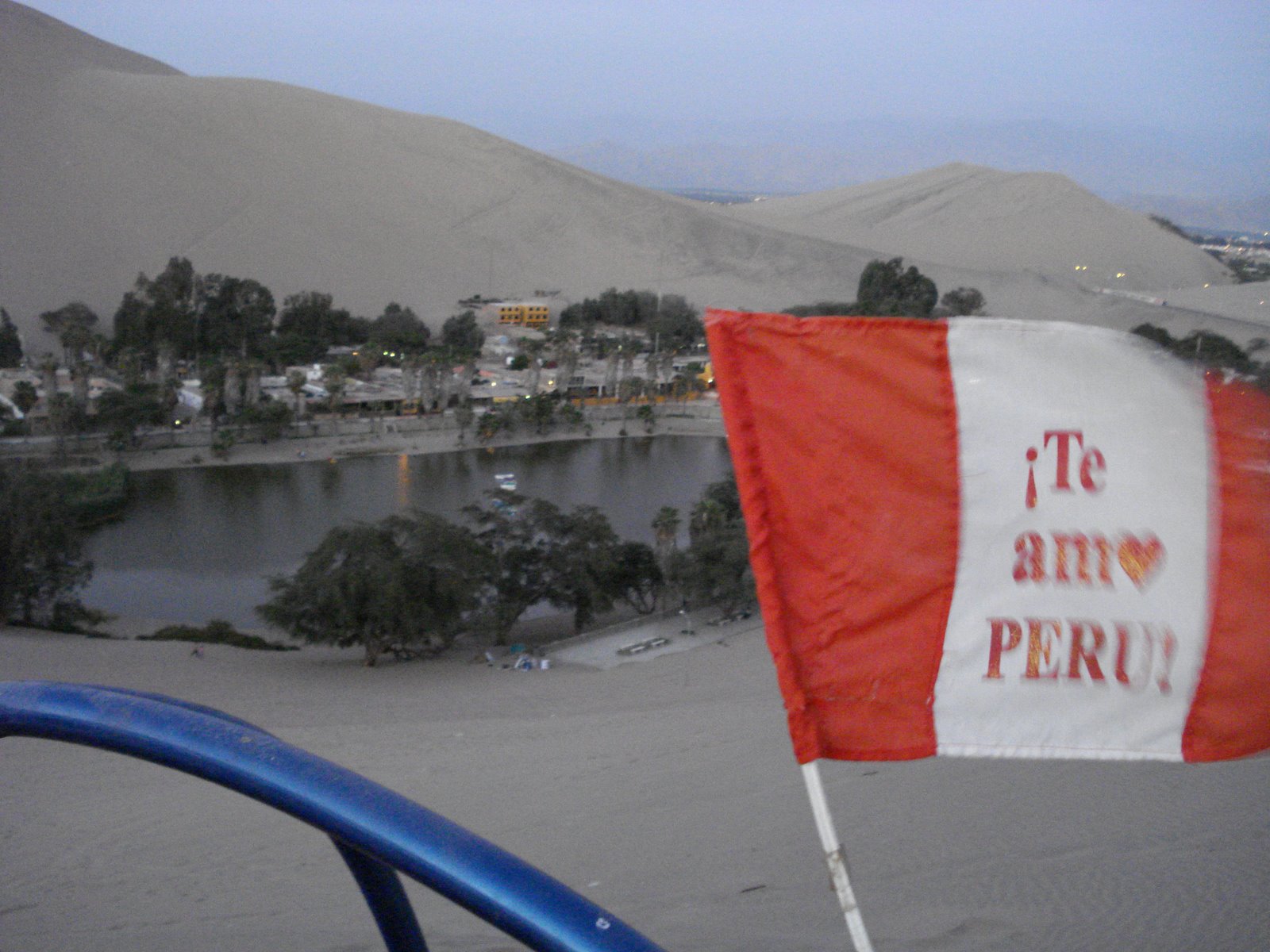
I ended up in the little oasis town just outside of Ica called Huacachina. The small community is surrounded by sand dunes on all sides and in the center is a murky looking puddle of water with supposed curative properties. According to the taxi driver that took me out to town people from all over Perú go there to bathe in the water. He claimed that people with AIDS and cancer had both been cured by a quick dip. Fortunately I was in good heath and did not have even a stubbed toe to dip into the tonic water, not that I would have expected anything more than for it to have come out wet.

This is an interesting facet of the rural culture throughout all of Latin America. Because of limited medical support (especially in the rural areas) people have to believe in the holistic cures (i.e. non-medical related cures). I have no problem with the concept, but there is a huge problem when modern medicine and the non-traditional medicines clash. People will believe that their curandero grandmother knows more about medicine than a trained medical professional. There is a large problem with people not trusting doctors or hospitals. for them it ofent comes down to who are they going to believe: a doctor you can't understand because he speaks educated Spanish with words that are too big for the commoner, or a trusted relative and friend that has known you for life. Under those conditions it is easy to see why they often go with the more accessible, cheaper, and friendlier local cure from family.

I will admit having tried some of the local remedies. Most work on a limited basis. The anti-diarrhea worked like a charm for long enough to get me to the doctor's office 4 hours away. Most decongestants are good for a while. The anti-parasite medicine didn't work at all. My beef is when parents give their child non-traditional medicine and it doesn't work, and they still don't go to the doctor . I tried to convince a friend in my site that he had to go to the hospital one time because he was really sick. He looked at me and said that he would never go to a hospital because, "that is where people go to die." Unfortunately there is no way to argue and win (despite perfect logic) with some Latinos on this topic.

In any case, Huacachina was a great place to sit for a couple of days and do absolutely nothing. There was blue skies, comfortable dry heat, good ceviche, and a hammock that swallowed me for more than one afternoon. One of the days I borrowed a sandboard which is made to look like a ghetto snowboard that includes Velcro straps and no edges, and went out on the sand dunes for some action. It turns out that sand boarding is actually quite boring standing up, with little ability to turn or control the general direction. The speed issue was a non-issue because even on the steepest areas it was slow at best.

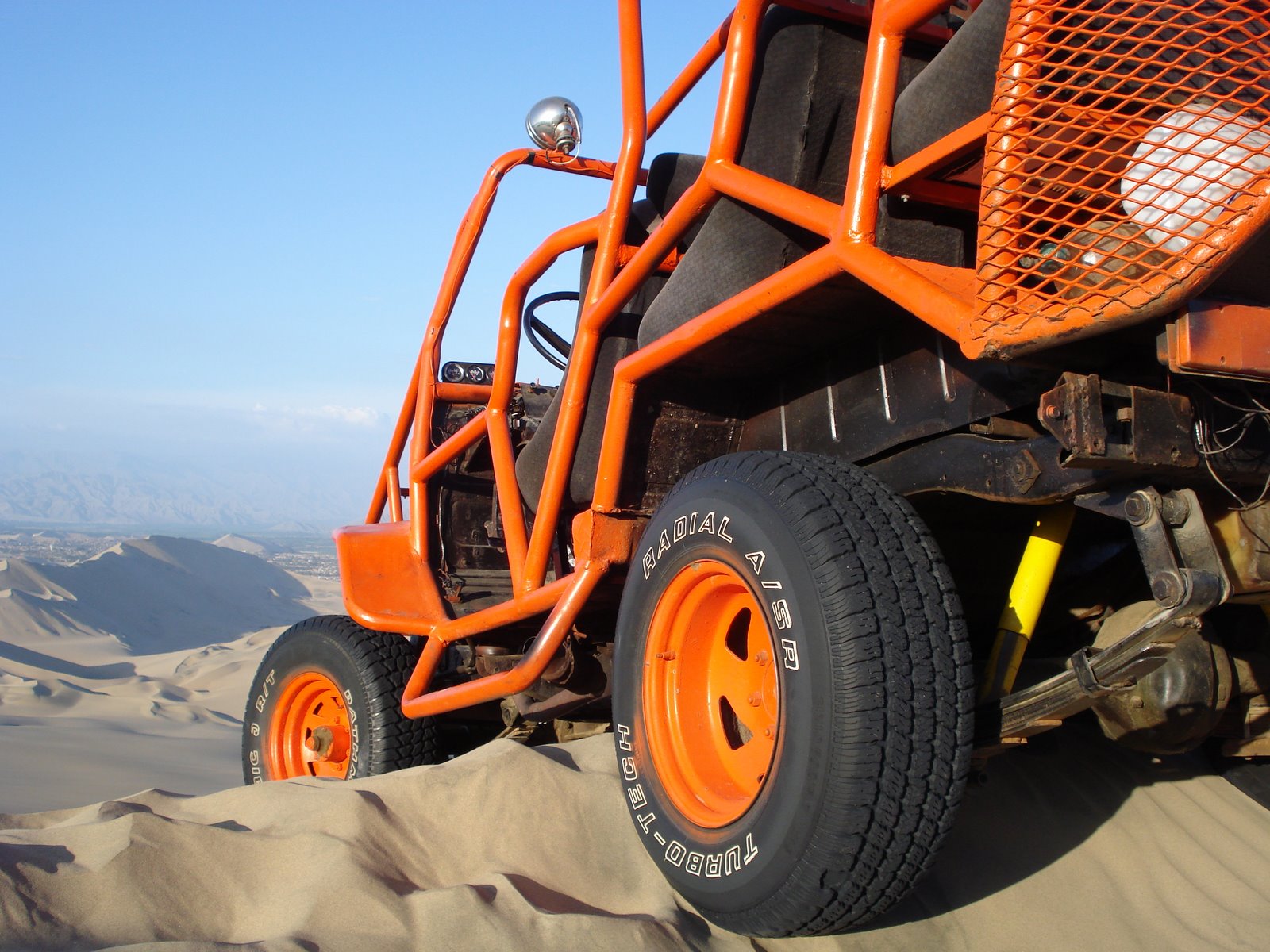
The last afternoon there I had the opportunity to go out on a dune buggy. This on the other hand was not boring. I had low expectations going in, expecting that some of the taxi/bus/chiva rides in Panama would reign supreme over a ride with a seatbelt in a dune buggy full of finicky tourists. The chiva rides still were scarier, but I have to hand it to our driver, it was brilliant and as fun as most rollercoasters. The sunset was epic and the stars over the never ending sand were impressively bright.

I felt a little bad about going to the area, especially since some may remember that back in August Perú experienced a rather large earthquake measuring 7.9 on the Ricketier Scale. The Ica was on the outer peripheral of the effected area, but due to cheap building materials the quake still had a devastating effect. Thousands died in Ica alone, and the memorial site constructed was rather impressive. In the end I told myself that the money that i was spending was helping people get back on their feet. In all, this time also helped me to relax and get back on my traveling feet as well. We had traveled hard to get down to Perú, and still had quite a ways to go to get to Cuzco. Relaxing on the oceanless beach turned out to be time well spent.

Monday, November 26, 2007

Head in the Clouds in Huaraz, Perú

Well Dave and I have separated again. I woke up in the bus to Lima to Dave standing over me with a knife I decided it was time for a break. I'm kidding of course, but Dave and I did parted ways as I jumped off in the middle of a town called Nowhere, Perú, clambered on to the next bus that came by, and ended up in Huaraz. Dave continued on to meet a friend who came to hike the Inka Trail with him. I will be meeting up with them in Cuzco in a few days.

Huaraz is the main jump off point for the Huaraz National Park. May-July is the high tourist season for climbing mountains and people from all over the world, especially Europeans, come to this area to take on the Andes. I had a great time wandering around town during local patron saint festival, bathing in hot springs, hiking around some pre-Inca ruins, and the highlight was a mountain bike ride though a glacier covered pass.

I woke up one morning a caught a bus up to the top of the pass headed east from Yungay over to the Amazon Basin. Before starting off on the decent, as is customary for every male, I had to pee on the other side of the pass so that I could race said urine to where the Amazon river meets the sea, where I hope to be in about ten weeks. After writing my name in the dirt (snow was too far away) it was just the gravel road guiding me back the way the bus had brought me. I had nothing but the Andes' glacier covered peaks to keep me company.

The road was all gravel and quite bad in parts. I was very glad to be going down for about 95% of the 45 km because at the top of the pass at 4767 m (15600 ft) just holding onto the bike was a hard enough work out. There was one section that required pedaling, and after three minutes of minimal work I couldn't buy a breath. In all my forearms burned to let go as my mind forced them to work. I was riding the brakes all the way through the 50-some-odd switchbacks, and by the end was ready to sit in the natural hot baths to soak away the pain, cold, and dirt that had collected on me all day.

The thing that was most curious to me about this area is how I was treated by the locals. I am used to being single out and looked at, over-charged whenever possible, asked for money, and generally put in the spotlight. In most tourist locations upon seeing a gringo generally a) don't stare as much or b) better disguise their looking. Not here! One might have thought that they had never before seen someone as white as I am (and I'm about as white as they come). I was asked several times to pose in a picture with random Peruvians, complimented for having blue eyes, yelled at, gawked at (different than staring), had my arm hair rubbed, and chased by kids while on the bike. Most of this stuff had happened to me before. The quantity of times it happened in a short period was what made me notice, because even in the depths of the Panama I was never followed so closely. I guess it is also different when you are familiar with the people staring -as in Panama, and when they are complete strangers -as in Perú. Basically it surprised me that a town with so much gringo tourism would be so shocked by my presence. Enough of me ranting, I'm off to Ica to see some sand.

Sunday, November 25, 2007

Final Breakdown on Ecuador:

Country of Origin: Colombia
Total time in country: 14 days, but only 6 on the main land.
Music: We have now entered the land of Andean music. This means charangos (10 string guitar), reed flutes, and sheep skin drums that the natives play. They could raise the dead to dance with their lively beats.
People: Galapagos people are a little tourist jaded, country folk are the same in all countries, and I think the artisans in the market would have sold their own children at ¨an extra special price just for you¨ (after all the kids are their handy-work).
Transport: Efficient, safe, and comfortable to the point of being boring.
Food: Exotic fruit juices with every meal, grilled potatoes to make a Texan jealous, and a variety of maize, chocho (a bean like food that locals can't get enough of), and the baked goods like bread and desserts are probably not French quality but they beat most of western Europe for sure. Club beer is the best beer I've had in Latin America, and has won several awards in European tastings.
Landscape: Variety is the spice of life and Ecuador has got it.
Safety: People said Quito was not safe, but we had no problem running around town on public transport and taxis. Outside of town the only danger is the old man that will not let you get off at your stop because he wants to talk more. Zero danger on Galapagos.
Gas prices: 1.48 USD / gal (Ecuador uses the dollar)
Surprised by: We did not realize how much there was to do just in the greater Quito area til we got there. There turned out to be quite a bit that we could have done in country but did not get to. 25 roses cost $1, and when they are in season can be found 50 for $1.
Final word: The Galapagos are not cheap, but the rest of the country is. Ecuadorians are use to dealing with tourists, even those that don't speak a word of Spanish. Any biologist, pretend biologist, or person that thinks flowers and animals are ¨pretty¨ could find something to love about Ecuador.
Next stop: Perú